Artificial Intelligence
AI chatbot cost for small businesses: what actually goes into the number
Short answer
AI chatbot cost combines a one-time setup and integration fee, a monthly platform subscription, and usage tied to conversation volume. For a small business the total varies with the platform, how many systems it connects to and how many conversations it handles monthly — there is no meaningful “average price.”
What actually makes up AI chatbot cost?
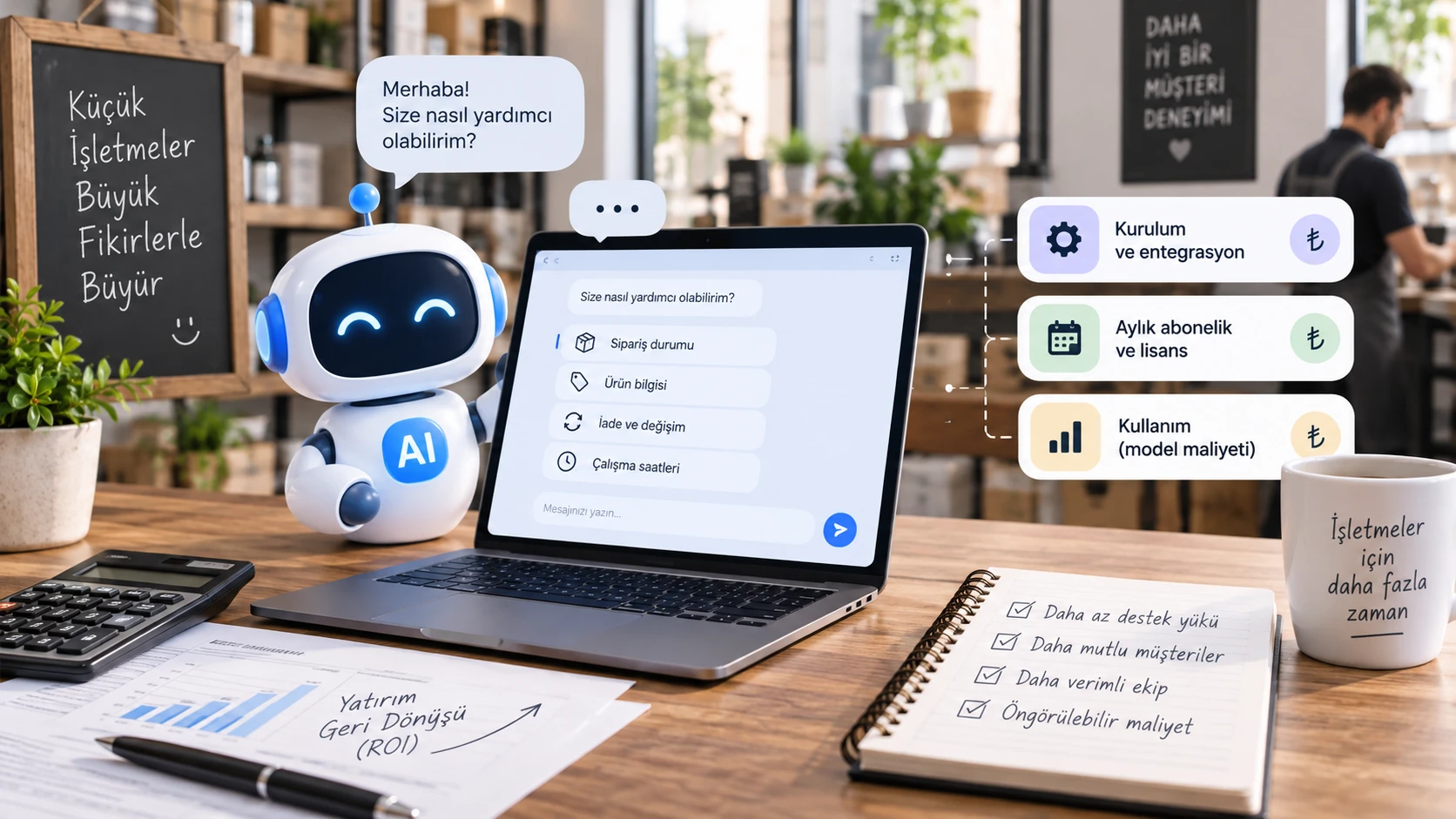
Judging a chatbot quote by a single number hides the real picture. In practice there are three distinct line items, each answering a different question:
- Setup and integration: the one-time work of connecting the bot to your website, WhatsApp, or an existing CRM/inventory system. The more systems it needs to talk to, the larger this item gets.
- Monthly subscription or licence: the right to use the platform itself. Some vendors charge a flat monthly fee, others charge per message or per conversation.
- Usage/model cost: if the chatbot runs on a large language model, an additional cost can scale with the volume of messages processed.
A quote that doesn’t separate these three may look attractive at first glance but can turn into an unexpected bill within a few months. Asking a vendor to break down AI chatbot cost into these three parts is the most basic — and most useful — first step.
Setup cost: a ready-made platform or a custom integration?
For most small businesses, the fastest route is a ready-made chatbot platform — most live-chat software now ships with an AI-powered layer. Setup typically takes a few days, and the cost is usually folded into the monthly subscription.
A custom integration — one that checks order status, queries inventory, or writes to a booking system — takes longer to build and carries a higher upfront cost. But as conversation volume grows, a ready-made platform’s per-use pricing can eventually exceed the fixed cost of a custom solution. The decision shouldn’t be based only on “what does this cost today,” but on the volume you expect over the next 12–18 months.
How does integration depth change the cost?
If the chatbot only answers frequently asked questions with text, integration is simple. But if it needs to look up an order number, update a CRM record, or check a payment status, each additional system connection means a separate development and testing cycle. At that point, the real cost comes not from how well the bot “converses,” but from how many systems it has to touch.
What drives monthly running cost?
Cost doesn’t stop once setup is done. On the operating side, four factors matter most: monthly message/conversation volume, the number of integrations, the level of customisation (a bot trained on brand-specific tone and complex scenarios costs more to build and maintain), and the capability tier of the underlying AI model. A high-volume, multilingual bot will naturally cost more to run than a low-volume, single-purpose one.
There’s a commonly overlooked line item here too: maintenance. As your product catalogue or pricing changes, the bot’s answers need updating — otherwise it risks giving customers wrong information. Whether that update work sits with your own team or your vendor should be spelled out clearly in the contract.
When does AI chatbot cost pay for itself?
The answer depends on how much workload the bot actually takes off your team. A joint IBM and Forrester assessment of Watson Assistant found that a human-handled support interaction costs around $6 on average, while a conversation fully resolved by AI (without human escalation) costs around $0.50. The same source notes that chatbots can, in theory, handle up to 80% of routine requests — though real-world deployments typically see a lower rate, since every business has its own mix of question types (IBM, “A Guide to AI Customer Service Chatbots”).
A simple way to translate this to your own business: look at last month’s support requests and count how many fell into the same handful of buckets (shipping status, opening hours, return policy, pricing). If that share is high, AI chatbot cost pays for itself quickly; if it’s low, payback takes longer, or the bot ends up being only a partial solution.
Factors that raise or lower the cost
A few practical principles keep the cost realistic:
- Start with a narrow scope. Having the bot answer only your top 5–10 recurring questions first shortens both setup and testing time.
- Start with one channel. Connecting to your website, WhatsApp and Instagram all at once costs more and multiplies risk; start with the channel your customers actually use most.
- Define the human hand-off threshold clearly. Letting the bot say “I don’t know this one, let me connect you to a person” protects customer satisfaction and removes the pressure — and cost — of automating every edge case.
- Read the contract by outcome, not just volume. Some vendors start with a low base fee and raise pricing sharply as message volume grows; ask about the growth scenario before signing.
Which businesses does this actually make sense for?
AI chatbot cost can’t be justified with the same argument for every business. For a business that gets repeated questions outside working hours, answers the same few topics constantly, or has support volume already straining its team, a chatbot can meaningfully improve both customer experience and team efficiency. For a business with low support volume, or where most conversations are unique and non-standard, the same investment pays back much more slowly.
It’s worth weighing this alongside the broader ways AI is used in marketing and sales; our guide to AI in digital marketing covers enterprise use cases beyond chatbots — content, operations and sales qualification — in more depth.
What to check when choosing a chatbot partner
When comparing quotes, ask: what are setup, subscription and usage cost, listed separately? How does pricing change as volume grows? Who updates the knowledge base, and how often? How is a wrong or incomplete answer caught and corrected? A vendor who can’t answer these clearly may be hiding costs behind an attractively low headline number.
What’s next
Once you break it down by these questions, AI chatbot cost is a predictable, understandable investment for most small businesses — the real risk is trusting a single bundled “package price” instead. If you’d like to work through where a chatbot would actually pay off for your business, and which conversations are genuinely worth automating, take a look at our enterprise AI service or get in touch.
Our group company YanıtLabs specialises in multi-channel AI customer response and manages this entire process — from setup to keeping the knowledge base current — as a managed service; for businesses that want to plan AI chatbot cost as a predictable monthly line item rather than a one-off quote, that can be a faster path than building it from scratch in-house.
If you plan to write the assistant’s instructions yourself, our guides to prompt engineering and building a Gemini Gem walk through the practical steps.
Frequently asked questions
Is AI chatbot cost a single line item?
No. It is usually three separate items: a one-time setup and integration fee, a monthly subscription or licence fee for the platform, and a variable usage cost tied to message volume or the underlying AI model. A quote that bundles all three into one number hides the real total.
Is a ready-made chatbot platform cheaper than a custom build?
In the short term, a ready-made platform is almost always cheaper because setup takes days, not weeks. As message volume grows or the bot needs deep integration with a CRM or inventory system, a custom build's total cost of ownership can fall below a platform's per-use pricing over time.
How long does it take for AI chatbot cost to pay for itself?
That depends on how much conversation volume the bot actually takes over. If a large share of your support requests are repetitive (shipping status, opening hours, pricing, return policy), payback is faster; if most conversations are unique and complex, it takes longer.
Does every small business need a chatbot?
No. It makes sense for businesses that get repeated questions outside working hours, answer the same handful of topics constantly, or have a support volume that already strains the team. If conversation volume is low, the return on investment can take a long time to materialise.
What happens if the chatbot gives a wrong answer?
That is a real risk, not a hypothetical one. Define clearly what the bot is allowed to decide on its own and when it must hand off to a human, and review real conversation logs regularly. A chatbot left with unlimited scope can create a reputation problem bigger than any cost overrun.